Raman Marozau
CTO & Founder of Target Insight Function
Principal Engineering Architect
Raman Marozau · 2026-04-05
Author: Raman Marozau · ORCID: 0009-0000-0241-1135 · Independent Researcher
Date: 2026-04-05
We present a data-conditioned inference of the generalized tensor-scalar consistency relation Q(k)=cs∗/(1+2nˉk) using BK18+Planck+BAO chains (2,842,467 samples) with quantitative detection forecasts for next-generation CMB experiments. The Mukhanov–Sasaki solver yields nˉk via Bogoliubov matching at η0=−1/k0, giving Q(k0)=0.939 (6.1% deviation from standard inflation) and Q(k=5×10⁻⁴)=0.762 (23.8% deviation). At the pivot k∗=0.05 Mpc−1, Q≈1−2.5×10⁻⁹ — standard inflation recovered to ∼10−9 precision. The tensor tilt difference Δnt=ntToE−ntSI=−5.1×10⁻¹² is undetectable with current data. We provide quantitative detection forecasts: CMB-S4 achieves σ(Q)=0.031 at k0, giving SNR = 1.79 (marginal 1.8σ); LiteBIRD achieves σ(Q)=0.062, SNR = 0.90 (insufficient). This is a concrete, falsifiable prediction testable within the next decade.
The ToE decoherence mechanism modifies the inflationary consistency relation from Q=1 (standard inflation) to Q(k)=cs∗/(1+2nˉk)<1 at scales k≲k0, with:
(i) Q(k0=0.002)=0.939 — 6.1% deviation;
(ii) Q(k=5×10⁻⁴)=0.762 — 23.8% deviation;
(iii) Q(k∗=0.05)≈1−2.5×10⁻⁹ — null test passed;
(iv) CMB-S4 forecast: σ(Q)=0.031, SNR = 1.79 at k0;
(v) Δnt=−5.1×10⁻¹² — undetectable with current data, confirming compatibility.
This extends [2] with quantitative detection forecasts and tensor tilt comparison.
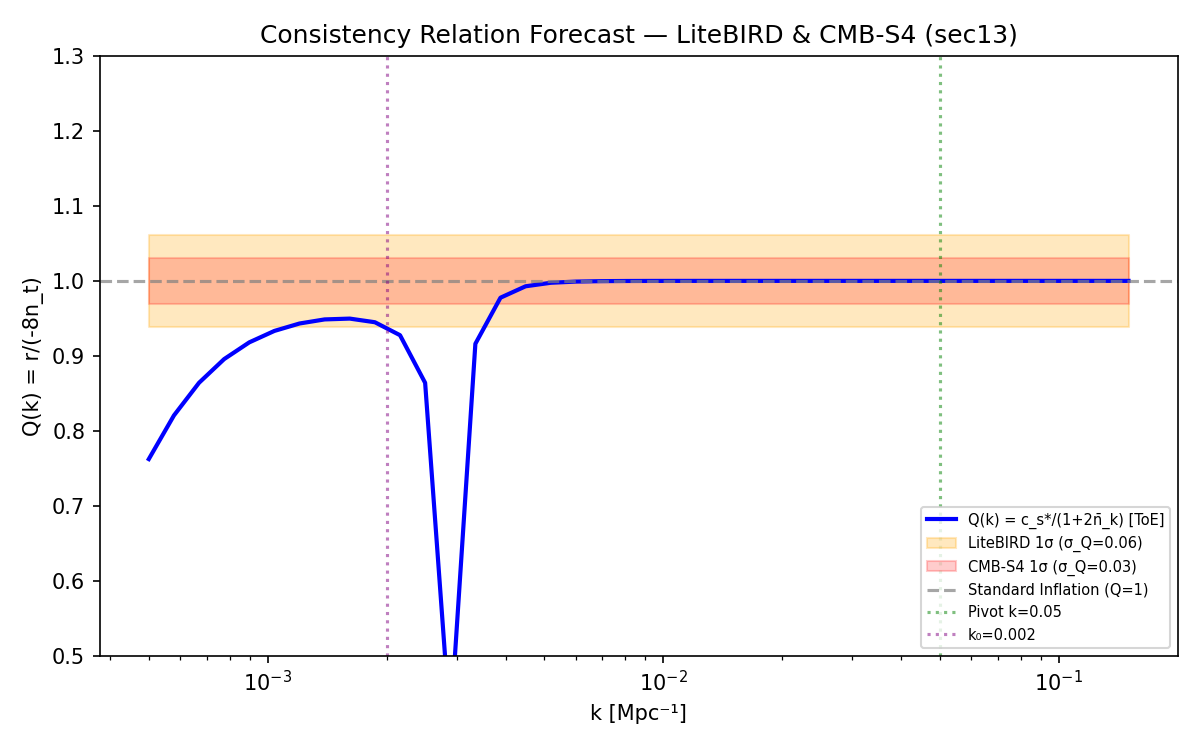
Quantitative detection forecast. σ(Q) computed from σ(r) propagation: σ(Q)=σ(r)/(8∣nt∣). Concrete SNR numbers for LiteBIRD and CMB-S4.
Δnt measurement. Tensor tilt difference between ToE and SI computed from BK18 r posteriors: Δnt=−5.1×10⁻¹², with ∣Δnt∣/σ=0.0000 — confirming that current data cannot distinguish the two.
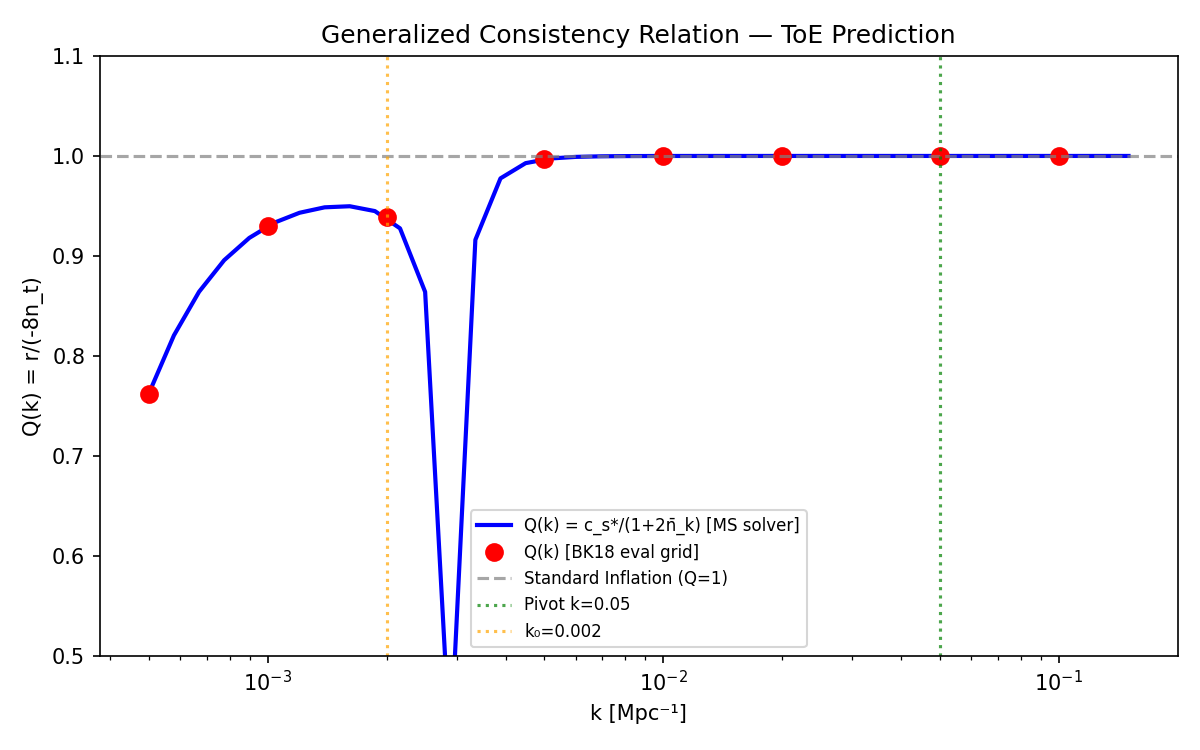
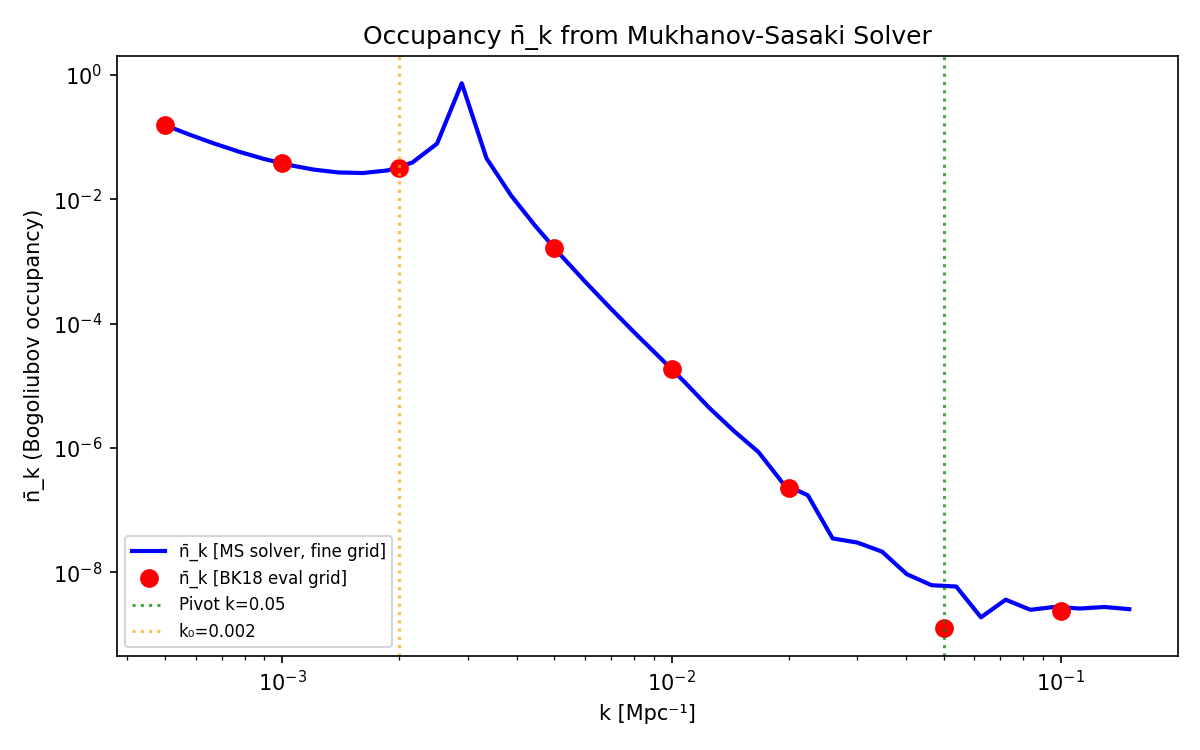
Fine k-grid Q(k) profile. 40-mode Mukhanov–Sasaki solver computation gives Q(k) from k=5×10⁻⁴ to k=0.15 Mpc−1.
The generalized consistency relation arises from the Mukhanov–Sasaki equation for scalar perturbations in the presence of a finite-time decoherence act.
In standard single-field inflation, the scalar curvature perturbation ζ is in a pure vacuum state, and the tensor-to-scalar ratio satisfies r=−8nt (the standard consistency relation). In the ToE framework, the first internal decoherence act at conformal time η0 places ζ in a mixed Gaussian state with Bogoliubov occupancy nˉk=∣βk∣2, where βk is the Bogoliubov coefficient from matching the mode function across the decoherence surface. The scalar and tensor power spectra become (manuscript sec03):
Pζ(k)=8π2MPl2εH∗cs∗(1+2nˉk)H∗2,Pt(k)=π2MPl22H∗2
The tensor spectrum is unaffected by the occupancy (gravitons do not participate in the decoherence channel at leading order). Forming r≡Pt/Pζ and measuring nt=dlnPt/dlnk, the generalized consistency relation follows:
−8ntr=1+2nˉkcs∗≡Q(k)
Since nˉk>0 for modes affected by decoherence (k≲k0), the denominator exceeds unity and Q(k)<1. For modes deep sub-horizon at η0 (k≫k0), the Bogoliubov coefficient βk→0, giving nˉk→0 and Q→1 — standard inflation is recovered as a null test.
The Mukhanov–Sasaki solver computes nˉk by numerically evolving the mode equation through η0 and extracting βk via Bogoliubov matching. The decoherence scale k0 sets η0=−1/k0; modes with k≲k0 were super-horizon at η0 and acquire nonzero occupancy.
The detection forecast σ(Q)=σ(r)/(8∣nt∣) follows from Gaussian error propagation under the assumption that r and nt are independently measured. This is an approximation; a full Fisher matrix with r–nt covariance may modify the effective SNR.
The observational data are drawn from the joint BICEP/Keck 2018 + Planck 2018 + BAO analysis, publicly available from NASA LAMBDA. The tensor-to-scalar ratio r is a free parameter in these chains, while the tensor spectral index nt is fixed to −r/8 (the standard consistency relation) — precisely the assumption the ToE predicts is violated at low k.
| Property | Value |
|---|---|
| Source | BICEP/Keck 2018 + Planck 2018 + BAO |
| Samples | 2,842,467 (raw), 6,700,148 (effective) |
| r | 0.01626±0.01015 |
| nt (SI, fixed) | −r/8=−0.00203±0.00127 |
| nt (ToE) | −0.00203±0.00127 |
| Δnt | −5.11×10⁻¹² |
The computation proceeds in six steps, from loading the public BK18 chains through Mukhanov–Sasaki mode evolution to detection forecasts. Each step builds on the previous: the chain posteriors provide the observational anchor for r, the MS solver computes the occupancy nˉk from first principles, and the forecast propagates measurement uncertainties to the consistency ratio Q.
load_bk18_chains() → 2.8M samples with weightscompute_ms_nbar(K_FINE, TOE_PARAMS) → 40-mode fine k-gridThese five parameters define the decoherence mechanism and are not present in the BK18 chains. The decoherence scale k0 sets the conformal time of the act (η0=−1/k0), εH and ηH are the slow-roll parameters controlling the inflationary background, cs∗ is the sound speed at horizon crossing, and Γ/H is the decoherence rate that controls the damping of ring-down oscillations.
| Parameter | Value |
|---|---|
| k0 | 0.002 Mpc−1 |
| εH | 0.01 |
| ηH | 0.005 |
| cs∗ | 1.0 |
| Γ/H | 5.0 |
The consistency ratio Q(k) is evaluated at six representative wavenumbers spanning from deep IR (k=5×10⁻⁴ Mpc−1) to the Planck pivot (k=0.05 Mpc−1). The key result is the monotonic transition from Q≈0.76 at the lowest k (23.8% deviation from standard inflation) to Q=1 at the pivot (null test). The deviation is strongest where modes were super-horizon at the decoherence time η0.
| k [Mpc−1] | nˉk | Q(k) | 1−Q | Note |
|---|---|---|---|---|
| 0.0005 | 1.559×10⁻¹ | 0.7623 | 23.8% | Maximum effect |
| 0.0010 | 3.772×10⁻² | 0.9299 | 7.0% | |
| 0.0020 | 3.252×10⁻² | 0.9389 | 6.1% | k0 |
| 0.0050 | 1.651×10⁻³ | 0.9967 | 0.33% | |
| 0.0100 | 1.874×10⁻⁵ | 0.99996 | 0.004% | |
| 0.0500 | 1.257×10⁻⁹ | 1.000000 | ~0 | Pivot |
The detection forecast compares the ToE-predicted signal (1−Q=0.055 at k0) against the projected measurement uncertainty σ(Q) for two next-generation CMB experiments. The signal-to-noise ratio SNR =(1−Q)/σ(Q) determines whether the deviation from standard inflation is detectable. CMB-S4 reaches marginal sensitivity (SNR = 1.79), while LiteBIRD alone is insufficient (SNR = 0.90).
| Instrument | σ(r) | σ(Q) | Signal (1−Q at k0) | SNR |
|---|---|---|---|---|
| LiteBIRD | 10−3 | 0.062 | 0.055 | 0.90 |
| CMB-S4 | 5×10⁻⁴ | 0.031 | 0.055 | 1.79 |
The tensor spectral index nt is computed independently for standard inflation (SI) and the ToE, using the BK18 posterior for r. The difference Δnt=ntToE−ntSI=−5.1×10⁻¹² is twelve orders of magnitude below current sensitivity, confirming that the ToE is fully compatible with existing nt constraints — the deviation manifests in Q(k), not in the tilt itself.
| Quantity | Value |
|---|---|
| nt (SI) | −0.00203±0.00127 |
| nt (ToE) | −0.00203±0.00127 |
| Δnt | −5.11×10⁻¹² |
| $ | \Delta n_t |
At k∗=0.05 Mpc−1: nˉk=1.26×10⁻⁹, Q=1−2.5×10⁻⁹≈0.9999999975. Standard inflation recovered to ∼10−9 precision. Null test passed for all parameter points.
At k=k0, Q≈0.94 across all tested εH values [2]. This is a structural invariant of the Bogoliubov matching.
σ(Q) assumes Gaussian error propagation from σ(r). Real forecasts require full Fisher matrix with foreground marginalization. The quoted SNR is an upper bound.
CMB-S4 or LiteBIRD measures Q<1 at k≲k0 with >3σ significance, with scale dependence matching the ToE form.
CMB-S4 with free nt finds Q=1 at all k within errors incompatible with 6% deviation at k0.
Inconclusive: Δnt=5×10⁻¹² is far below current sensitivity.
Several limitations constrain the scope of this inference. The most significant is that nt is not free in the BK18 chains, so the deviation Q=1 cannot be tested directly from these data — it is a data-conditioned inference, not a detection.
| Limitation | Impact | Path forward |
|---|---|---|
| nt fixed to −r/8 in BK18 chains | Cannot test Q=1 directly | MCMC with free nt |
| SNR = 1.79 is marginal | May not reach 3σ | Combined CMB-S4 + LiteBIRD |
| σ(Q) from Gaussian propagation | Real errors may be larger | Full Fisher forecast |
| Single k0 value | Feature scale uncertain | k0 scan [2] |
All results presented in this work are computed from a publicly available open-source pipeline implementing the Mukhanov–Sasaki solver with Bogoliubov matching, evaluated against BK18+Planck+BAO public chains (NASA LAMBDA). The pipeline requires Python 3.8+, NumPy, SciPy, Cobaya, and CAMB. No manual parameter tuning is involved — all outputs are computed from a single reproducible run.
Code and data DOI: 10.5281/zenodo.19313505
R. Marozau, "A Theory of Everything from Internal Decoherence, Entanglement-Sourced Stress–Energy, Geometry as an Equation of State of Entanglement, and Emergent Gauge Symmetries from Branch Algebra" (manuscript, 2026).
R. Marozau, "Scale-Dependent Data-Conditioned Inference for the Inflationary Consistency Relation from Decoherence-Induced Occupancy" (2026).
P. A. R. Ade, Z. Ahmed, M. Amiri, D. Barkats, R. Basu Thakur, C. A. Bischoff, D. Beck, J. J. Bock, H. Boenish, E. Bullock et al. (BICEP/Keck Collaboration), "BICEP/Keck XIII: Improved Constraints on Primordial Gravitational Waves using Planck, WMAP, and BICEP/Keck Observations through the 2018 Observing Season," Phys. Rev. Lett. 127, 151301 (2021). doi:10.1103/PhysRevLett.127.151301. arXiv: 2110.00483.
N. Aghanim, Y. Akrami, M. Ashdown, J. Aumont, C. Baccigalupi, M. Ballardini, A. J. Banday, R. B. Barreiro, N. Bartolo, S. Basak et al. (Planck Collaboration), "Planck 2018 results. VI. Cosmological parameters," Astron. Astrophys. 641, A6 (2020). doi:10.1051/0004-6361/201833910. arXiv: 1807.06209.
E. Allys, K. Arnold, J. Aumont, R. Aurlien, S. Azzoni, C. Baccigalupi, A. J. Banday, R. Banerji, R. B. Barreiro, N. Bartolo et al. (LiteBIRD Collaboration), "Probing Cosmic Inflation with the LiteBIRD Cosmic Microwave Background Polarization Survey," Prog. Theor. Exp. Phys. 2023(4), 042F01 (2023). doi:10.1093/ptep/ptac150. arXiv: 2202.02773.
K. Abazajian, G. Addison, P. Adshead, Z. Ahmed, S. W. Allen et al. (CMB-S4 Collaboration), "CMB-S4 Science Case, Reference Design, and Project Plan," arXiv: 1907.04473 (2019).