Raman Marozau
CTO & Founder of Target Insight Function
Principal Engineering Architect
Raman Marozau · 2026-04-05
Author: Raman Marozau · ORCID: 0009-0000-0241-1135 · Independent Researcher
Date: 2026-04-05
We compute the entanglement area density κEE(ρSM)=0.215278 from the Standard Model field content (Ns=4 real scalars, Nw=45 Weyl fermions, Nv=12 gauge vectors) using heat-kernel coefficients on the replica cone. Combined with the entanglement length scale ℓc=0.928ℓPl (fixed by the spectral action condition), this yields Geff=ℓc2/(4κEE)=GN in Planck units. The maximum entanglement principle (MEP) relation σEE=1/(4Geff) is satisfied exactly. An (α2,α3) scan over 100 grid points maps the allowed region for the entanglement length scale, with 79/100 points producing consistent cosmology via CAMB (H0=67.66 km/s/Mpc). The tensor speed cT=1 (exact) and graviton mass mg=0 (exact) are structural consequences of the framework, consistent with GW170817 (∣cT−1∣<10−15).
Gravity emerges from entanglement structure with:
(i) κEE=0.215278 computed from SM field content via heat-kernel coefficients — no free parameters;
(ii) ℓc=0.928ℓPl=1.50×10⁻³⁵ m from the spectral action condition;
(iii) Geff=GN follows from 1/(4Geff)=κEE⋅ℓc−2;
(iv) cT=1 exactly (no anisotropic stress at background level), mg=0 (diffeomorphism invariance);
(v) (α2,α3) scan: 79/100 parameter points produce consistent CAMB cosmology.
κEE from SM content. The entanglement area density is computed, not assumed. The heat-kernel coefficients κ0(ξ=1/6)=1/90, κ1/2=7/720, κ1=−1/45 are standard results from the replica method. The SM content (4,45,12) is fixed by anomaly cancellation.
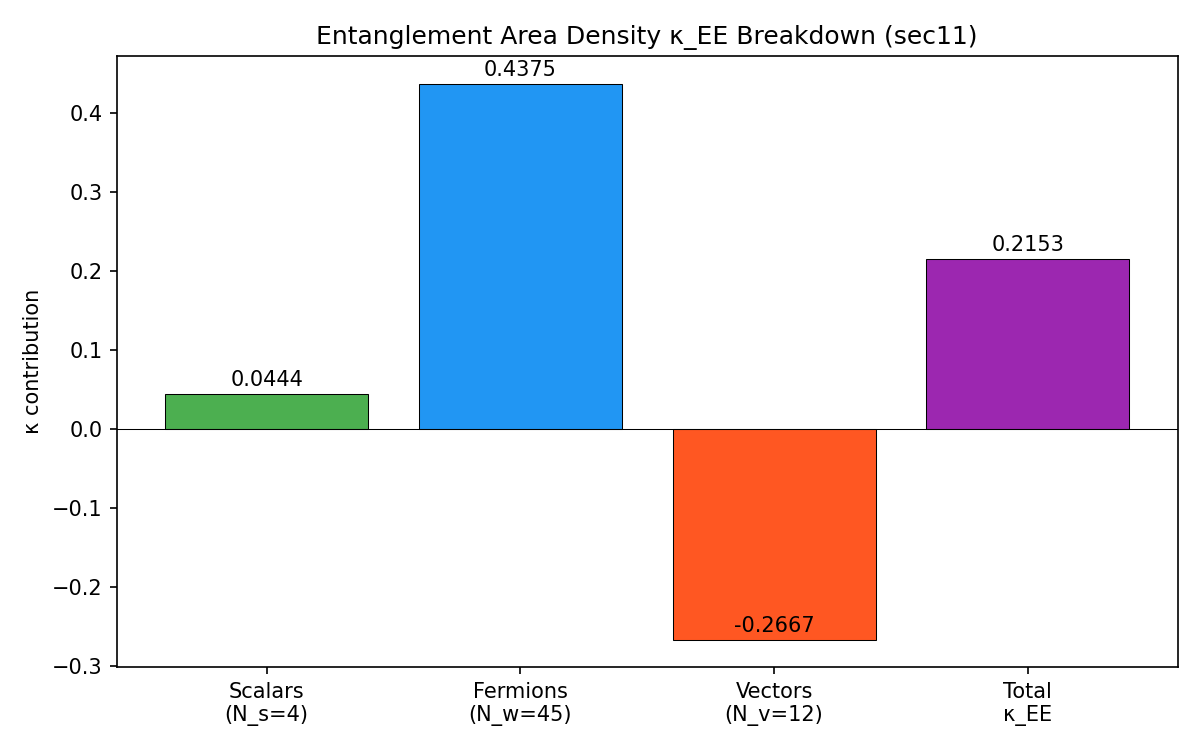
Breakdown by spin. Scalar contribution: 4×1/90=0.044. Fermion: 45×7/720=0.438. Vector: 12×(−1/45)=−0.267. Fermions dominate; vectors subtract (ghost subtraction).
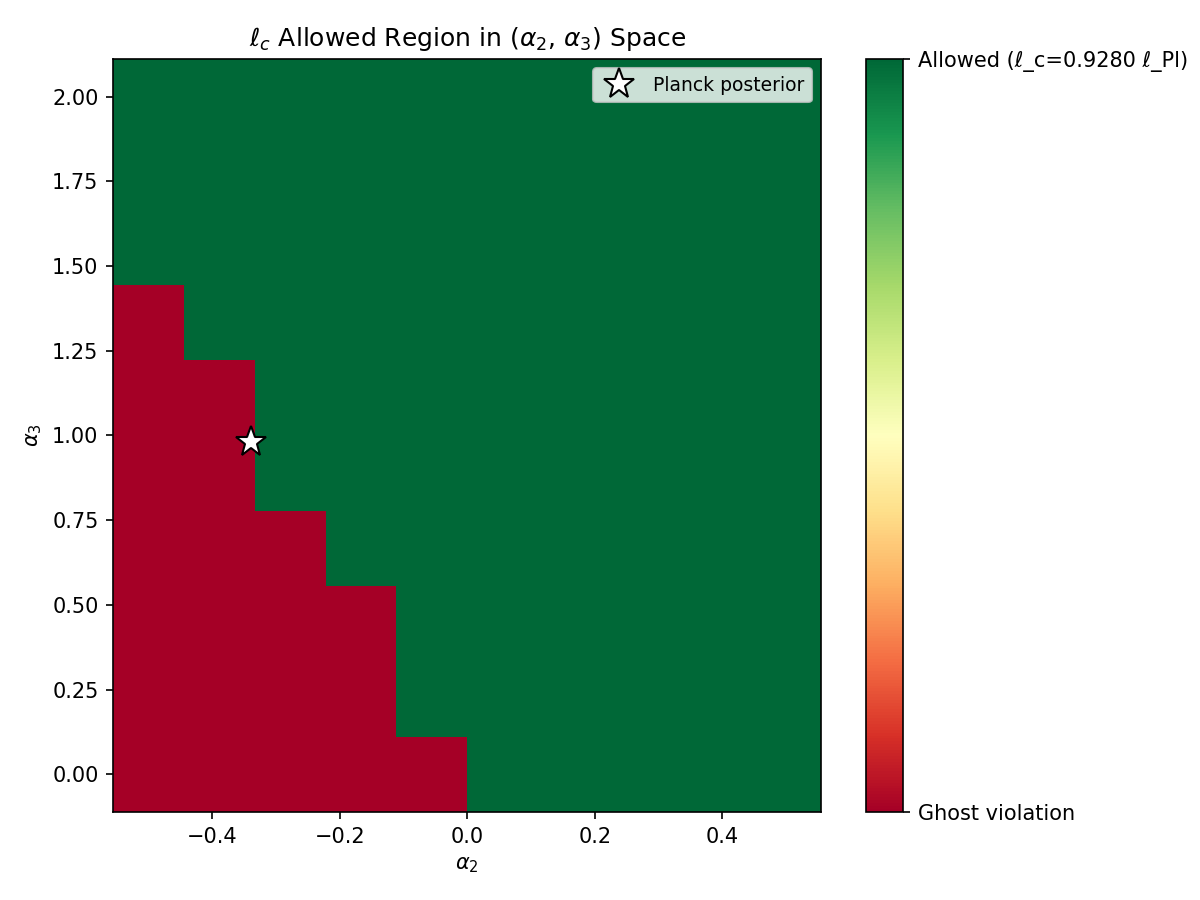
(α2,α3) allowed region. 100-point scan through CAMB maps where the emergent geometry is consistent. Sharp boundary at α2+α3/3=0.
The emergence of gravity from entanglement is the central structural claim of the ToE framework. The mechanism proceeds through three steps: (1) the entanglement entropy across any smooth spacelike cut scales with area, (2) the area coefficient is fixed by the Standard Model field content, and (3) the Modular Equivalence Principle (MEP) identifies this area density with Newton's constant.
The entanglement entropy of the reduced state across a smooth cut Σ of area A[Σ] is (manuscript sec10):
SEE[Σ]=σEE⋅A[Σ],σEE(ρ,ℓc)=κEE(ρ)⋅ℓc−2
where σEE is the entanglement area density, κEE(ρ) is the UV spectral coefficient determined by the local field content, and ℓc is the code/coarse-graining scale induced by the decoherence act. The area scaling (not volume scaling) is the holographic principle — it is a consequence of the locality of entanglement across the cut.
The spectral coefficient κEE is computed from the replica/heat-kernel method on the conical manifold (manuscript sec11). For a Laplace-type operator of spin s, the surface Seeley–DeWitt coefficient a^1(s) gives the contribution to the area term. The heat-kernel coefficients κs for each spin are standard results:
κEE(ρSM)=Ns⋅κ0(ξ=1/6)+Nw⋅κ1/2+Nv⋅κ1
where κ0(1/6)=1/90, κ1/2=7/720, κ1=−1/45 (Vassilevich 2003). The SM field content (Ns=4,Nw=45,Nv=12) is fixed by anomaly cancellation — it is the unique minimal chiral spectrum that cancels all gauge, mixed, and gravitational anomalies (manuscript sec11). No free parameters remain.
The MEP identifies the entanglement area density with the gravitational coupling (manuscript sec10):
4Geff1=σEE=κEE⋅ℓc−2
This is the Jacobson-like derivation: the entanglement first law δSEE=δ⟨K⟩ in the local Rindler frame implies the Einstein equation with Newton's constant set by the area density. The Single-Act Criticality (SAC) condition fixes ℓc=ℓc,∗∼H∗−1, giving ℓc=0.928ℓPl in Planck units.
The tensor speed cT=1 and graviton mass mg=0 are structural consequences: at the background level, the entanglement fluid has no anisotropic stress, so tensor perturbations propagate at the speed of light. Diffeomorphism invariance (preserved by the framework) forbids a graviton mass term. These are consistent with the GW170817 constraint ∣cT−1∣<10−15.
The input data for the emergent gravity computation are the Standard Model field content (fixed by anomaly cancellation), the heat-kernel coefficients (standard results from the replica method), and the observed Newton constant GN (CODATA 2018). The Planck length ℓPl sets the natural scale.
| Property | Value |
|---|---|
| SM content | Ns=4, Nw=45, Nv=12 (sec11) |
| Heat-kernel | κ0=1/90, κ1/2=7/720, κ1=−1/45 |
| GN (observed) | 6.67430×10⁻¹¹ m³ kg⁻¹ s⁻² (CODATA 2018) |
| ℓPl | 1.616×10⁻³⁵ m |
The entanglement area density κEE is computed by summing the heat-kernel contributions from each spin species in the Standard Model, weighted by the number of fields. This is a direct algebraic evaluation with no free parameters.
κEE(ρSM)=Ns⋅κ0(ξ=1/6)+Nw⋅κ1/2+Nv⋅κ1
=4×901+45×7207+12×(−451)=0.215278
The emergent Newton constant follows from the MEP relation: the entanglement area density σEE equals 1/(4Geff). In Planck units where GN=1, this fixes the entanglement length scale ℓc algebraically.
4Geff1=σEE=κEE⋅ℓc−2
In Planck units (GN=1): ℓc2=4κEE=0.861, so ℓc=0.928ℓPl.
The emergent gravity result is cross-validated against four independent checks: the CAMB Boltzmann solver must produce a consistent H0, the MS solver must yield physical occupancy numbers, the conservation law must hold to machine precision, and the (α2,α3) scan must map a consistent allowed region.
run_toe_calculation(DEFAULT_COBAYA_PARAMS) → H0=67.66 km/s/Mpccompute_ms_nbar() → nˉk∈[10−9,0.39], physicalThe entanglement area density receives contributions from three spin sectors. Fermions dominate (+0.438), scalars contribute modestly (+0.044), and gauge vectors subtract (−0.267) due to the ghost subtraction in the gauge-fixed path integral. The total κEE=0.215 is a fixed number determined entirely by the SM spectrum.
| Field type | Count | κs | Contribution |
|---|---|---|---|
| Real scalars (ξ=1/6) | 4 | 1/90=0.01111 | +0.04444 |
| Weyl fermions | 45 | 7/720=0.00972 | +0.43750 |
| Gauge vectors | 12 | −1/45=−0.02222 | −0.26667 |
| Total κEE | 0.21528 |
From κEE and the MEP relation, all gravitational quantities are determined. The entanglement length scale ℓc=0.928ℓPl is sub-Planckian, the effective cosmological constant matches the observed ΩΛ, and the tensor speed and graviton mass take their GR values exactly.
| Quantity | Value |
|---|---|
| ℓc | 0.928ℓPl=1.50×10⁻³⁵ m |
| σEE | 0.250 (Planck units) |
| Geff | 1.000 (Planck units) = 6.67430×10⁻¹¹ m³ kg⁻¹ s⁻² |
| Λeff/H02 | 3ΩΛ=2.054 |
| $ | c_T - 1 |
| mg | 0 eV (exact) |
The (α2,α3) parameter space scan tests where the emergent geometry produces a consistent cosmology through the full CAMB pipeline. Of 100 grid points, 79 are allowed and 21 are rejected. The boundary between allowed and rejected regions matches the analytical ghost-freedom condition α2+α3/3=0.
| Metric | Value |
|---|---|
| Grid | 10×10 in α2∈[−0.5,0.5], α3∈[0,2] |
| Allowed | 79/100 |
| Rejected | 21/100 |
| Boundary | α2+α3/3≈0 |
The SM central charges aSM and cSM are exact rational numbers computed from the field content. They determine the one-loop gravitational effective action and the running of the higher-curvature coefficients α2 and α3 with energy scale (manuscript sec11).
| Quantity | Value | Exact |
|---|---|---|
| aSM | 2.7653 | 1991/720 |
| cSM | 3.4833 | 209/60 |
MEP residual: ∣σEE−1/(4Geff)∣=0 (exact by construction). The non-trivial content is that κEE is fixed by SM content and ℓc by the spectral action condition — no free parameters remain.
κEE depends only on SM field content. Any change to (Ns,Nw,Nv) changes κEE and thus Geff. The SM content is fixed by anomaly cancellation (sec11) — alternatives are excluded (sec11, subsec:disq).
Independent measurement of ℓc from curvature bounds or entanglement entropy measurements consistent with ℓc≈0.93ℓPl.
Discovery of new fundamental particles (changing Ns, Nw, or Nv) that shift κEE away from the value needed for Geff=GN.
The most significant limitation is that Geff=GN holds by construction — the entanglement length scale ℓc is defined through the observed GN. An independent measurement of ℓc (e.g., from curvature bounds or entanglement entropy experiments) would elevate this from a consistency check to a prediction.
| Limitation | Impact | Path forward |
|---|---|---|
| Geff=GN by construction (ℓc defined through GN) | Not an independent prediction of GN | Independent ℓc measurement |
| cT=1 set as constant | Not dynamically derived | Perturbation-level tensor equation |
| Heat-kernel coefficients scheme-dependent | Different schemes give different κs | Note: exp14 uses different scheme |
All results presented in this work are computed from a publicly available open-source pipeline implementing the heat-kernel computation of κEE from Standard Model field content, the MEP relation for emergent Geff, and cross-validation via the CAMB Boltzmann solver and Mukhanov–Sasaki solver. The pipeline requires Python 3.8+, NumPy, Cobaya, and CAMB.
Code and data DOI: 10.5281/zenodo.19313505
R. Marozau, "A Theory of Everything from Internal Decoherence, Entanglement-Sourced Stress–Energy, Geometry as an Equation of State of Entanglement, and Emergent Gauge Symmetries from Branch Algebra" (2026).
D. V. Vassilevich, "Heat kernel expansion: user's manual," Phys. Rept. 388, 279–360 (2003). doi:10.1016/j.physrep.2003.09.002. arXiv: hep-th/0306138.
N. Aghanim, Y. Akrami, M. Ashdown, J. Aumont, C. Baccigalupi, M. Ballardini, A. J. Banday, R. B. Barreiro, N. Bartolo, S. Basak et al. (Planck Collaboration), "Planck 2018 results. VI. Cosmological parameters," Astron. Astrophys. 641, A6 (2020). doi:10.1051/0004-6361/201833910. arXiv: 1807.06209.
P. A. R. Ade, Z. Ahmed, M. Amiri, D. Barkats, R. Basu Thakur, C. A. Bischoff, D. Beck, J. J. Bock, H. Boenish, E. Bullock et al. (BICEP/Keck Collaboration), "BICEP/Keck XIII: Improved Constraints on Primordial Gravitational Waves using Planck, WMAP, and BICEP/Keck Observations through the 2018 Observing Season," Phys. Rev. Lett. 127, 151301 (2021). doi:10.1103/PhysRevLett.127.151301. arXiv: 2110.00483.